

Most structural joinery failures stem from the invisible thirst of an untreated MDF edge. You've likely watched premium adhesive soak into a porous core, leaving a weak bond that's destined for delamination. It's a waste of material that forces unnecessary workshop downtime. Using the correct contact adhesive for mdf requires more than just raw strength; it demands a high-solids delivery system that stays on the surface where it's needed most.
We agree that inconsistent coverage and bubbling in laminates are unacceptable for high-value contracts. This article demonstrates how to achieve permanent, high-strength bonds using professional spray canisters whilst avoiding common trade pitfalls. You'll discover the technical advantages of high-solids formulations and how to configure adjustable spray hardware for maximum efficiency. We'll outline the exact steps to reduce workshop downtime and ensure a consistent, professional finish on every industrial project.
Key Takeaways
- Master the "double-coat" technique to prevent porous MDF edges from starving joints and ensuring a permanent bond.
- Compare the cost-per-square-metre efficiency of 22L canister systems against traditional aerosols and liquid tubs.
- Select the correct contact adhesive for mdf to maintain high heat resistance and prevent delamination in demanding environments.
- Optimise workshop output using adjustable spray hardware that reduces cleanup time and material waste.
- Identify the critical differences between "starved joints" and "over-drying" to eliminate common bonding failures on high-value projects.
Why MDF Requires a Specific Contact Adhesive Approach
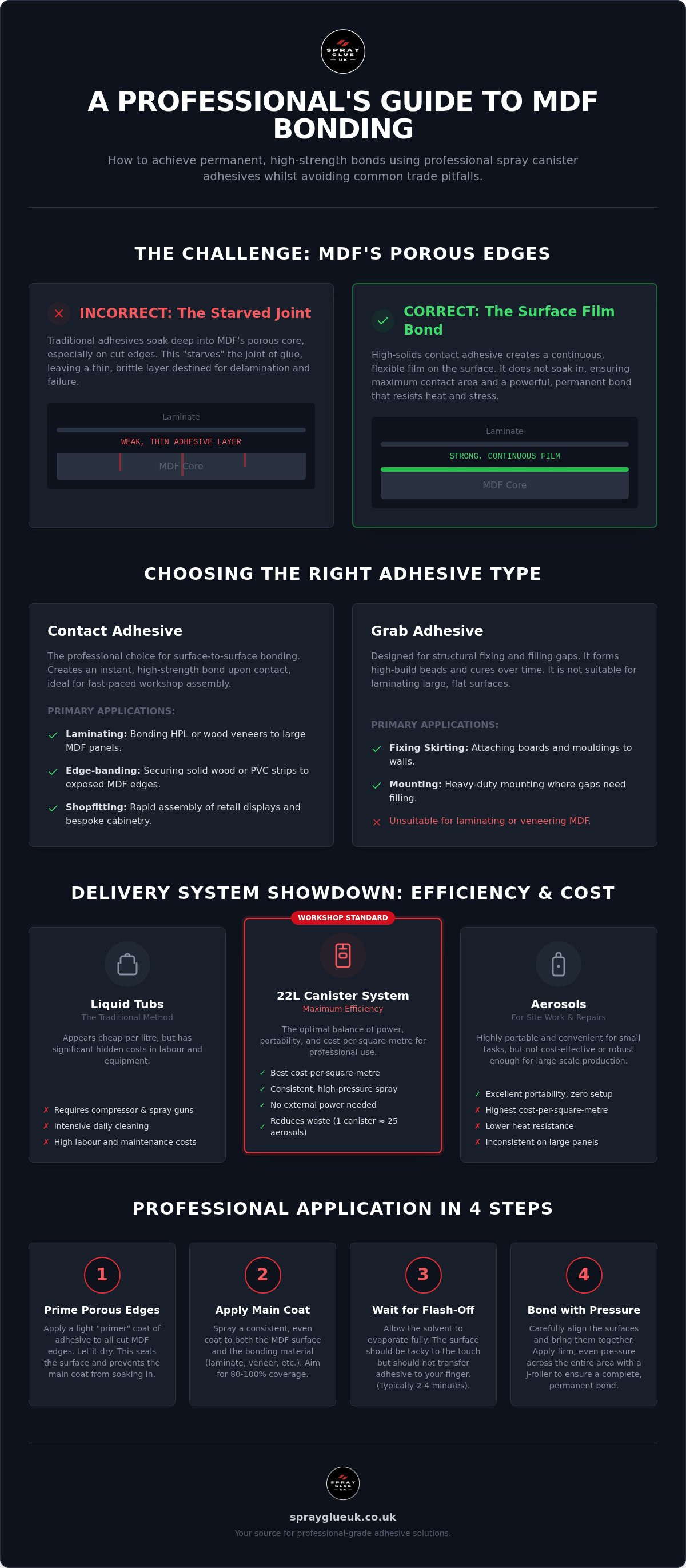
MDF is a staple of British joinery, but its physical properties demand a specific bonding strategy. It is a non-homogeneous substrate. Whilst the faces are compressed into a dense, smooth skin, the internal core and exposed edges remain highly porous. This structural inconsistency is the primary cause of bond failure. Traditional PVA glues rely on moisture to penetrate the wood, but MDF fibres absorb this moisture too rapidly. This starving of the joint leaves the adhesive brittle and unable to support the weight of laminates or heavy veneers.
Professional contact adhesive works differently. It creates a continuous, flexible film on both surfaces. Instead of soaking into the board, it sits on the surface to provide maximum contact area. This method is essential for high-value projects where delamination isn't an option. High-solids formulations are particularly effective here. They ensure that even after the solvent has flashed off, enough adhesive remains to bridge the gap between the MDF and the bonding material.
The Problem with Porosity and Soak-In
MDF edges are notoriously thirsty. The fibrous structure acts as a capillary system, drawing liquid adhesives deep into the board's core. This leads to the starved joint phenomenon. The adhesive layer becomes too thin to fuse the surfaces, resulting in immediate or delayed failure. Using a high-solids contact adhesive for mdf solves this. It provides the necessary "meat" on the surface to resist absorption. In professional workshops, this behaviour is managed by applying a primer coat to the edges, ensuring the final bond has a solid foundation to grip.
When to Use Contact Adhesive vs Grab Adhesive
Choosing the wrong adhesive type leads to project failure. Grab adhesives are designed for structural fixing where high-build beads fill gaps. They are unsuitable for laminating or veneering. Contact adhesive is the professional choice for surface-to-surface bonding. Use it for the following applications:
- Laminating: Bonding HPL or wood veneers to large MDF panels.
- Edge-banding: Securing solid wood or PVC strips to exposed MDF edges.
- Shopfitting: Rapid assembly of retail displays and bespoke cabinetry.
Contact adhesive provides the green strength required for immediate handling. In a fast-paced workshop, this is a major advantage. Once the two surfaces meet, the bond is instant. You don't need to wait for hours under mechanical clamps. This allows for immediate trimming, routing, or finishing, significantly reducing workshop downtime and increasing overall output.
Choosing the Right Delivery System: Canister vs Aerosol vs Liquid
Efficiency in a professional workshop depends on the delivery method as much as the adhesive chemistry. Traditional liquid tubs (often 5L) are frequently cited as an industry standard, but they carry hidden costs. They require dedicated compressors, separate spray guns, and intensive daily maintenance. The time spent cleaning equipment and managing solvent lines eats directly into project margins. Conversely, aerosols are portable but lack the propellant volume and pressure required to coat large MDF panels consistently.
The 22L canister system represents the pragmatic middle ground for industrial bonding. It provides the high-pressure delivery of a compressor-fed system with the portability of an aerosol. When calculating the true cost-per-square-metre, canisters consistently outperform both alternatives. Tubs appear cheaper per litre but lose value through labour-intensive setup. Aerosols are the most expensive per square metre due to their lower solids-to-propellant ratio. For those looking to upgrade, a Spray Adhesive Starter Kit offers a complete "plug-and-play" solution for the workshop.
The 22L Canister: The Industrial Workshop Standard
Canister systems like Premium Bond 22L are engineered for rapid production. They eliminate the need for external power or air sources. The constant internal pressure ensures a consistent, heavy web spray pattern. This is vital when applying contact adhesive for mdf over large surface areas. It prevents the uneven coverage and "dry spots" that lead to laminate bubbling. One 22L canister replaces approximately 20 to 25 standard aerosols, significantly reducing hazardous waste and the logistical burden of stock management.
Aerosols for Site Work and Small Repairs
Aerosols remain an essential tool for specific scenarios. For site-based installations or minor snagging, Multi Purpose Spray Adhesive Aerosols are the most pragmatic choice. They require zero setup and fit easily into a tool bag. However, they have clear limitations. They lack the high heat resistance required for permanent bonds in demanding environments, such as shop windows or kitchens. Whilst they are perfect for small repairs, they should not be the primary tool for full-scale MDF panel production where bond integrity and speed are paramount.
Step-by-Step: Professional Application for MDF Panels
Achieving a zero-fail bond on MDF requires a methodical approach to surface preparation and application. Shortcuts in the workshop lead to delamination on-site. Professional results depend on managing the physical properties of the board whilst ensuring the adhesive performs to its technical specification. Every stage, from the initial sand to the final roll, must be executed with precision to maintain the integrity of high-value joinery.
Preparing the Substrate for Maximum Adhesion
Surface cleanliness is the foundation of a permanent bond. Factory-produced MDF often carries residual release agents or wax from the manufacturing process. These contaminants prevent the contact adhesive for mdf from biting into the fibres. Always sand the board faces lightly with 120-180 grit paper. This opens the grain and provides a mechanical key for the adhesive film.
Once sanded, remove all particulates immediately. A standard workshop brush is insufficient; use a tack rag or high-pressure compressed air to clear the pores. Environmental conditions are equally critical. Ensure the workshop, the adhesive, and the substrates are at a minimum temperature of 15°C. Cold substrates cause the adhesive to "shock," resulting in poor transfer and a brittle bond that will fail under stress.
Spraying Technique and Flash-Off
Using a 22L canister system allows for precise control over the spray pattern. Maintain a consistent distance of 10-15cm from the substrate. Move the Adjustable Contact Adhesive Gun in a steady, overlapping motion to ensure 100% coverage without pooling. The goal is a uniform web that covers the surface without soaking through.
Managing flash-off times is a critical stage. The solvents must evaporate fully before the surfaces are mated. Test the adhesive with the back of your finger; it should be "tack-free" and must not transfer to your skin. Rushing this process traps solvents between the layers. This entrapment causes the laminate to bubble as the gases attempt to escape over time, particularly when exposed to sunlight or heat.
The Double-Coat Technique for Porous Edges
MDF edges require a specific "double-coat" strategy. Because the core is less dense than the face, it absorbs the first pass of adhesive almost instantly. Apply a light primer coat to all exposed edges and allow it to dry completely. This seals the fibres and prevents the joint from "starving." Apply the second coat only after the primer has flashed off. This ensures a consistent adhesive film remains on the surface to meet the corresponding bonding material. Finally, apply heavy pressure using a J-roller. Start from the centre and work outwards. A chemical bond requires this physical force to ensure total contact and eliminate air pockets.
Avoiding Common MDF Bonding Failures
Joinery failure is expensive. On-site delamination damages reputations and increases remedial costs. Most failures with contact adhesive for mdf occur because the technical limitations of the glue or the substrate were ignored. Identifying these risks during the workshop phase is the only way to ensure long-term bond integrity. Professional troubleshooting focuses on heat resistance, application consistency, and timing.
Telegraphing is a common aesthetic failure. When using thin veneers or high-gloss laminates, any irregularity in the adhesive layer shows through the surface. Pooled adhesive or uneven spray patterns create visible lumps. A fine, consistent web spray is mandatory. This is achieved through proper hardware calibration. Solvent entrapment is another preventable risk. Bonding whilst the adhesive is still wet traps gas between the layers. As the temperature rises, these gases expand, causing the laminate to bubble and lift away from the MDF core.
Solving the Heat Resistance Challenge
Standard contact adhesives often fail when exposed to direct sunlight or internal heating. In shopfitting and kitchen installations, substrates undergo significant thermal expansion. If the adhesive lacks high-temperature stability, the bond softens and shears. Premium Bond 22L is specifically engineered to maintain its structural properties in these environments. It handles the stresses of composite panel movement without losing tack. Always verify heat resistance by performing a sample bond and exposing it to a heat lamp before proceeding with large-scale production.
Managing Edge Delamination
Edge delamination is usually the result of a "starved joint." This differs from over-drying, where the adhesive has exceeded its open time and lost its ability to bond. A starved joint occurs when the porous MDF edge absorbs the adhesive, leaving nothing on the surface. Use the "Two-Pass" rule to prevent this. Apply a primer coat to the edge, wait five minutes for it to seal the fibres, and then apply the final bonding coat. This builds the necessary film thickness.
Edge-banding requires higher localised pressure than face laminating. The narrow surface area makes it easy to miss spots. Utilise an Adjustable Contact Adhesive Gun to tighten the spray pattern. This focuses the adhesive precisely on the edge, reducing overspray and ensuring 100% coverage. Following the second coat, use a J-roller with maximum manual force to fuse the surfaces together. This mechanical pressure is what activates the chemical bond, ensuring the edge-banding remains secure for the life of the project.
Optimising Workshop Efficiency with Premium Bond 22L
Workshop efficiency is measured by production speed and the minimisation of waste. For high-volume MDF projects, the transition from traditional liquid tubs to a 22L canister system provides an immediate uplift in output. The primary advantage is the elimination of equipment maintenance. Unlike compressor-fed guns that require daily solvent flushing, a canister system is a closed loop. The adhesive remains pressurised and ready for use indefinitely. This reduces cleanup time to almost zero, so joiners don't have to spend hours on tool maintenance at the end of a shift.
Selecting a high-performance contact adhesive for mdf like Premium Bond 22L ensures that rapid production doesn't compromise bond quality. In industrial settings, the ability to move from spraying to bonding in minutes is vital. This speed, combined with the reliability of a high-solids formula, makes it the preferred choice for bespoke cabinetry and shopfitting. It's a system designed for the fast-paced nature of modern trade work.
The Advantages of Adjustable Hardware
Precision is the key to reducing material costs. Standard spray systems often suffer from excessive overspray, which wastes product and creates additional cleaning tasks on surrounding surfaces. Using an Adjustable Contact Adhesive Gun allows the operator to calibrate the fan pattern to the specific task. Whether coating a narrow MDF edge or a large 8x4 panel, the spray width can be tuned for maximum efficiency.
This hardware control can reduce adhesive waste by up to 30%. Industrial-grade guns and hoses are built for the rigours of a daily workshop environment, offering far greater durability than disposable alternatives. The bespoke spray patterns ensure that the adhesive is placed exactly where it's needed, maintaining the clean workspace required for high-value projects. It's a professional setup that prioritises utility over gimmicks.
Cost-Benefit Analysis of Canister Systems
When evaluating the total cost of ownership, canister systems provide a superior return on investment compared to liquid tubs or aerosols. A single 22L canister provides significantly more coverage per square metre because the high-solids content remains on the surface of the MDF. Tubs often require multiple coats due to high solvent absorption, which increases both material consumption and labour time.
A single joiner using a canister system can produce more bonded panels in a day than a team using manual application methods. The reduction in setup and breakdown time directly increases the profit margin on every project. For businesses looking to modernise their production line, you can View our Premium Bond 22L Starter Kits for professional workshops to find a complete, high-performance solution that integrates seamlessly into any industrial workflow.
Secure Your Workshop Production Standards
Professional joinery success requires moving away from inefficient liquid tubs and low-pressure aerosols. You've seen that managing the specific porosity of MDF edges is the only way to prevent starved joints and delamination. High-solids formulations provide the necessary surface film for permanent, heat-resistant bonds. By integrating a 22L canister system, you eliminate daily equipment maintenance and significantly reduce material waste through adjustable spray patterns. Precision hardware ensures that every gram of adhesive is placed exactly where it's needed.
Selecting the correct contact adhesive for mdf ensures your workshop maintains high output without compromising on finish quality. Our systems are engineered specifically for the rigours of industrial production, providing reliable results on high-value projects. We provide UK-wide delivery on all industrial canisters, ensuring your supply chain remains robust. Our high-solids formula and adjustable guns provide the technical foundation for zero-fail bonds on every substrate.
Shop the Premium Bond 22L Range for Industrial MDF Bonding and secure the professional finish your workshop demands. Precise equipment delivers predictable results.
Frequently Asked Questions
Is contact adhesive the best glue for MDF-to-MDF bonding?
Contact adhesive is the superior choice for surface-to-surface bonding, such as laminating two sheets together to increase thickness. It provides immediate green strength, allowing for instant processing without the need for mechanical clamps. However, for structural mitre or butt joints, a high-quality PVA or specialised wood glue is more appropriate. Use contact adhesive for mdf when the project requires large surface areas to be fused quickly and permanently.
How long should I let contact adhesive dry on MDF before bonding?
You must wait until the adhesive is tack-free to the touch before mating the surfaces. This typically takes between 2 and 5 minutes depending on workshop temperature and airflow. Rushing this stage traps solvents, which leads to bubbling and bond failure later. The adhesive should feel sticky but must not transfer to your finger. If the adhesive is still wet, the chemical bond cannot form correctly.
Can I use a brush to apply contact adhesive to MDF edges?
Brushing contact adhesive onto MDF edges is inefficient and often results in a sub-standard finish. Hand-brushing creates thick, uneven ridges that can telegraph through thin veneers or high-gloss laminates. Professional workshops utilise spray canisters to achieve a uniform web pattern. This ensures consistent coverage across the entire edge whilst minimising the risk of pooling or dry spots that lead to eventual delamination.
Why is my contact adhesive soaking into the MDF?
Adhesive soaks into MDF because the internal core and exposed edges are highly porous. This soak-in leads to a starved joint where no adhesive remains on the surface to create a bond. To prevent this, utilise a high-solids adhesive and apply a primer coat to the thirsty edges. Once the first coat has flashed off and sealed the fibres, apply a second coat to ensure a reliable surface film remains.
What is the best way to bond laminate to an MDF countertop?
The most effective method involves using a 22L canister system for a consistent, high-pressure spray. Apply the adhesive to both the MDF face and the laminate underside. Wait for the correct flash-off time, then align the pieces carefully. Use a heavy J-roller, starting from the centre and moving outwards, to apply maximum pressure. This physical force is essential to activate the chemical bond across the entire surface area.
Do I need to sand MDF before applying contact adhesive?
Yes, you must sand the MDF faces with 120-180 grit paper before application. Factory-produced boards often have a smooth, resin-rich surface or residual release agents that inhibit adhesive penetration. Light sanding removes these contaminants and creates a mechanical key for the contact adhesive for mdf to grip. Always ensure the board is completely free from dust using a tack rag or compressed air after sanding is complete.
Is spray adhesive heat resistant enough for kitchen use?
Industrial spray adhesives are engineered for high heat resistance, but standard multi-purpose aerosols often fail in kitchen environments. Near ovens or hobs, temperatures can rise enough to soften low-grade adhesives, causing delamination. Premium Bond systems are designed to withstand these thermal stresses. Always check the technical data sheet to ensure the adhesive's temperature rating exceeds the expected conditions of the final installation site to prevent failure.
How do I clean a contact adhesive spray gun if it clogs?
If a spray gun clogs, it is usually due to adhesive drying in the tip after being left disconnected. Use a specialised solvent cleaner to dissolve the blockage. However, professional canister systems are designed as closed loops; if you leave the gun and hose attached to a pressurised canister with the valve open, the system will not clog. Only clean the external tip of the gun regularly to maintain a perfect spray pattern.