

Relying on 500ml aerosol cans for large-scale industrial bonding is a strategy for project delays and budget overruns. When you're facing difficult plastics or high-volume installs, the wrong adhesive choice leads to immediate bond failure and wasted labour. You've likely dealt with the frustration of slow drying times and equipment that clogs just when the deadline is tightest. These technical hurdles don't just slow down production; they erode your margins and compromise your professional reputation.
This guide ensures you master the technical requirements for high tack spray adhesive UK to deliver fail-safe, structural bonds on every project. We'll show you how to transition from expensive aerosols to professional 22L canister systems that significantly reduce your cost-per-square-metre and eliminate workshop mess. You'll gain a clear understanding of the latest 2026 industrial standards, including the mandatory training requirements for specific chemical compounds. We cover everything from the precision of adjustable contact adhesive guns to the specific application methods required for roofing membranes and heavy-duty substrates. It's time to swap guesswork for professional-grade reliability and industrial efficiency.
Key Takeaways
- Understand how high solids content and aggressive initial grab ensure permanent, structural bonds on porous MDF and challenging LSE plastics.
- Compare the technical advantages of 22L canister systems over standard aerosols to optimise your high tack spray adhesive UK procurement and reduce project downtime.
- Learn how to use adjustable contact adhesive guns to control spray patterns, minimising workshop mess and significantly reducing your cost-per-square-metre.
- Identify the correct professional-grade solution for your specific sector, from general industrial bonding with Premium Bond to specialised membrane work with Roof Tack.
- Ensure your workshop remains compliant with 2026 UK safety standards and mandatory training requirements for industrial-strength adhesive applications.
Understanding High Tack Spray Adhesive: More Than Just Initial Grab
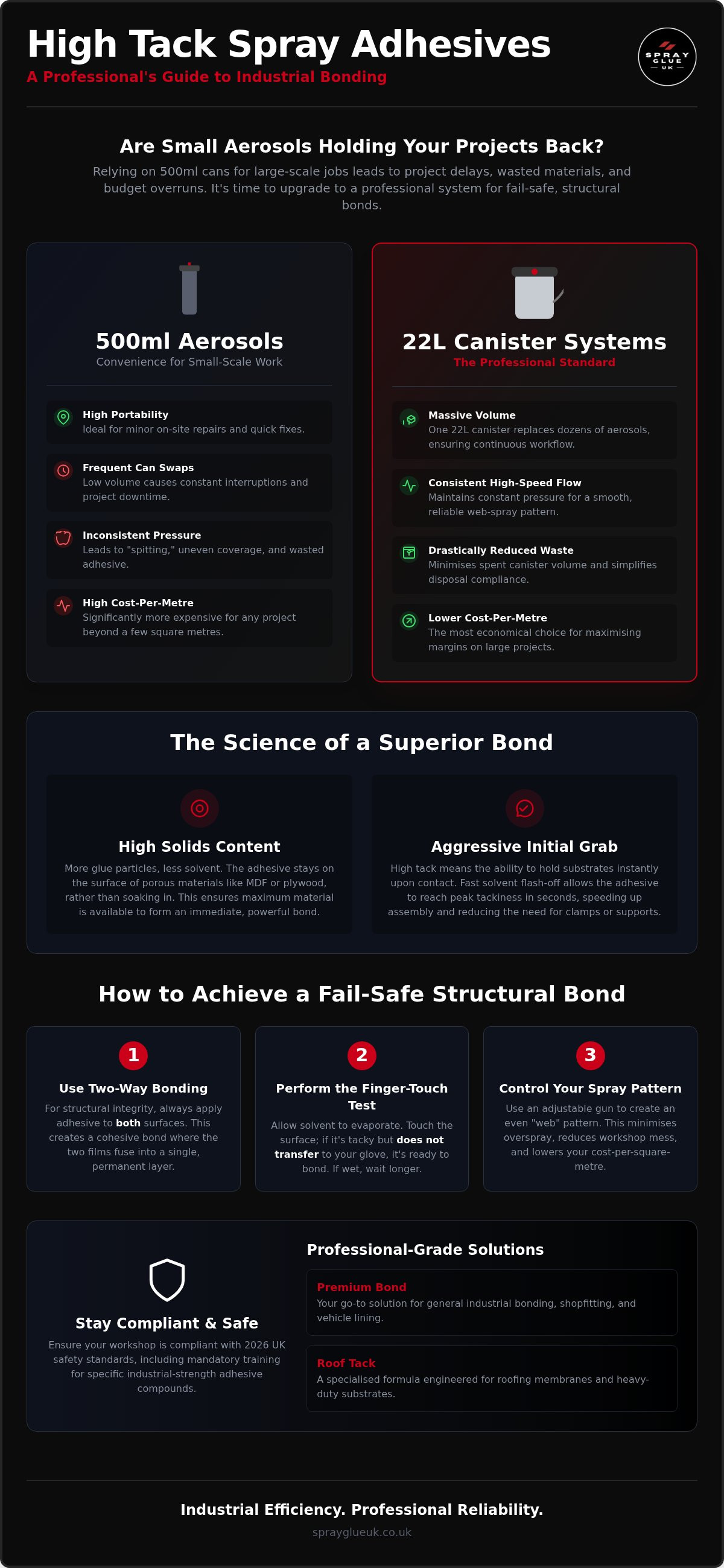
High tack is often misunderstood as simple stickiness. In the professional trade, it refers to an aggressive initial grab combined with high solids content. This combination is essential for high tack spray adhesive UK applications where immediate positioning and weight-bearing are required. While many different types of adhesives exist, high tack formulations are specifically engineered for speed and reliability in fast-paced industrial environments. It's the difference between a bond that holds and one that fails under its own weight.
Open time is a critical factor in your workflow. This is the window between application and the point where the adhesive becomes too dry to bond. In industrial settings, a balanced open time is vital. If it's too short, you can't position large sheets or complex components. If it's too long, production stalls and labour costs rise. It's also vital to remember that "tack" doesn't always equal final bond strength. The tack is the "grab" that holds the piece while the chemical cure takes place. Achieving a permanent, structural bond requires the adhesive to fully set after the initial contact.
The Chemistry of High Solids Adhesives
High solids adhesives contain a higher percentage of glue particles relative to the solvent carrier. This is a massive advantage when working with porous materials like MDF, plywood, or timber. The glue stays on the surface rather than soaking into the grain, ensuring more material is available to form the bond. High tack is the ability to hold heavy substrates immediately upon contact. Fast solvent flash-off ensures the adhesive reaches its peak tackiness in seconds. This chemistry allows for faster assembly times and reduces the volume of product needed to achieve a secure fix.
One-Way vs. Two-Way Bonding Techniques
Your application method dictates the final bond integrity. One-way bonding involves spraying a single surface. This is only suitable for lightweight materials like thin foams, paper, or temporary templates. For structural requirements, two-way bonding is mandatory. You must apply the high tack spray adhesive UK to both substrates, allow the solvent to evaporate, and then press them together. This creates a cohesive bond where the two adhesive films fuse into a single layer.
Use the finger-touch test to verify readiness. Touch the adhesive film with a clean finger or glove. If the adhesive is tacky but doesn't transfer to your skin, it's ready for bonding. If it's still wet or transfers, wait longer. If it's hard and dry, you've exceeded the open time and must reapply.
UK trades rely on these high-performance systems for shopfitting, exhibition stands, and vehicle lining. In these sectors, downtime is expensive. Using a professional-grade system ensures that once a panel is pressed, it stays put, eliminating the need for mechanical fixings or rework.
Aerosols vs. 22L Canister Systems: Which Format Wins?
Choosing between 500ml aerosols and 22L canister systems is a decision between convenience and industrial performance. Aerosols offer unmatched portability for site work and minor repairs. However, for consistent throughput, they fail. Low volume leads to frequent canister swaps, while pressure drops cause the adhesive to "spit", resulting in uneven coverage and wasted material. In a high-volume workshop, the time lost to managing small cans quickly erodes project margins.
The 22L canister is the benchmark for high tack spray adhesive UK standards. These systems provide a continuous, high-speed delivery that aerosols cannot match. Beyond speed, the environmental impact is a significant factor for UK trade professionals. A single 22L canister replaces dozens of 500ml cans, drastically reducing the volume of spent canisters in trade waste and simplifying disposal compliance. For any project exceeding a few square metres, the canister format is the logical choice for efficiency and cost control.
Canister Systems: The Professional Standard
Pressurised 22L systems like Premium Bond use a dedicated propellant to maintain constant pressure from the first litre to the last. This eliminates the "spitting" common in aerosols, ensuring a smooth, web-spray pattern every time. These are closed systems; because the adhesive isn't exposed to air until it leaves the gun, the setup is virtually maintenance-free. When using an Adjustable Contact Adhesive Gun, you gain total control over the spray width. This precision allows you to move from broad coverage to narrow detailing without changing equipment, a level of control no aerosol nozzle can provide.
Starter Kits for Workshop Upgrades
Transitioning to industrial systems is straightforward with a Spray Adhesive Starter Kit 22L Canister + Gun & Hose. These kits include everything required to move from manual cans to a professional production line. Setup takes minutes: simply connect the hose to the canister and gun, tighten the fittings, and open the valve. The ROI is immediate. By reducing the cost-per-square-metre and eliminating the downtime associated with aerosol failure, most workshops see the kit pay for itself within the first few large-scale installs. Investing in a professional starter kit is the most efficient way to upgrade your workshop and ensure consistent bond integrity across every project.
Essential Substrates: Achieving Structural Bonds on MDF, Plastics, and Rubber
Structural integrity depends entirely on the compatibility between the adhesive and the substrate. In the UK industrial sector, materials range from standard timber to complex Low Surface Energy (LSE) plastics like Polyethylene and Polypropylene. These plastics are notorious for bond failure because their surface structure resists wetting. A standard adhesive will simply bead up and peel away. A high-spec high tack spray adhesive UK professionals trust must have the chemical profile to "bite" into these surfaces, creating a permanent mechanical link where others fail.
Bonding fabric and foam presents a different challenge: aesthetics. If the adhesive is too thin or applied too heavily, you risk "strike-through", where the glue penetrates the face of the fabric. It can also cause "dimpling", leaving the finished surface looking uneven. Using a web or lace spray pattern ensures the adhesive sits on the surface of the foam, providing an immediate grab without compromising the visual finish. This precision is essential for upholstery, automotive trimming, and acoustic panel installation.
Woodworking and Shopfitting Requirements
Raw MDF edges are a common point of failure due to high absorption rates. Without sufficient solids content, the material drinks the adhesive, leaving nothing on the surface to form a bond. Applying a heavier coat or a second pass on these edges is standard practice in professional workshops. For kitchen installs and commercial shopfitting, heat resistance is a non-negotiable specification. Laminates bonded near heat sources or under high-intensity lighting require a high-temperature stable bond to prevent delamination over time. The lace-pattern delivery of professional systems ensures a flush, flat finish essential for high-end cabinetry.
Specialist Bonding: Roofing and Rubber
The UK roofing sector demands adhesives that can withstand extreme temperature fluctuations and moisture. Roof Tack 22L is specifically formulated for securing EPDM and other roofing membranes. It provides the aggressive grab needed to hold large sheets in place during installation, whilst maintaining flexibility once cured. This flexibility is vital; it allows the bond to accommodate the natural expansion and contraction of the roof structure. When selecting a high tack spray adhesive UK for heavy-duty rubber flooring or waterproof membranes, you must ensure it can handle the specific environmental stresses of the British climate.
Maximising Coverage: How to Reduce Waste and Cost per Square Metre
Effective procurement for high tack spray adhesive UK projects requires a shift in mindset. You shouldn't judge value by the cost of a single canister. Instead, focus on the cost-per-square-metre. High-volume 22L systems provide a significantly lower price point per litre of usable adhesive compared to 500ml aerosols. Efficiency is driven by yield. If you're losing 20% of your product to overspray or pooling, your project margins are disappearing into the workshop floor. Achieving 100% coverage doesn't require a heavy, wet coat. It requires a controlled, uniform application that maximises the contact area without wasting material.
Nozzle selection is the first step in yield management. A standard nozzle might be sufficient for general tasks, but specialised tips allow you to match the spray pattern to the substrate width. This prevents adhesive from landing where it isn't needed. Using a professional adjustable contact adhesive gun allows you to fine-tune the delivery to the exact requirements of the job, ensuring every gram of adhesive contributes to the bond strength.
Calibrating Your Adjustable Spray Gun
Precision begins with calibration. Use the adjustment screw on the rear of the gun to set the width of the lace pattern. For large panels, a wide fan increases speed. For narrow edges or trim, a tight pattern prevents waste. You must also control the flow rate to match your walking speed. If you move slowly with a high flow, you'll get pooling. If you move too fast, the coat will be too thin. The perfect coat is a consistent web-like pattern across 80-100% of the surface. This ensures maximum surface area contact while allowing the solvents to flash off correctly.
Calculating Yield and Project Requirements
Yield varies significantly between formats. A 22L canister typically provides the coverage of approximately 40 to 50 aerosol cans, depending on the solids content and application thickness. However, several factors can reduce this yield. Overspray is the most common culprit, especially in poorly ventilated areas or when using incorrect gun settings. For external projects using Roof Tack 22L, wind speed can carry adhesive away from the target, requiring a closer spray distance and tighter pattern. Always plan for a 10-15% contingency in industrial adhesive orders. This buffer accounts for substrate porosity on materials like raw MDF and ensures you don't run out of product mid-shift, which causes expensive downtime.
Professional Adhesive Solutions: Why UK Trades Choose Spray Glue UK
Spray Glue UK functions as a dedicated partner for high-volume trade users across the country. We don't simply sell glue. We provide engineered bonding systems designed to eliminate the common failures associated with retail-grade products. For professionals seeking a reliable high tack spray adhesive UK source, our focus remains on the 22L canister format. This industrial standard ensures consistent pressure, higher yield, and significantly reduced waste compared to traditional aerosols. Our national delivery network and technical support ensure your production line or project site never faces avoidable downtime. We understand the pace of modern trade. Our logistics are built to support that speed with precision and reliability.
The Premium Bond and Roof Tack Difference
Premium Bond 22L serves as our primary industrial workhorse. Its formulation features a high solids content that prevents substrate absorption, making it the ideal choice for woodworking, automotive trimming, and general manufacturing. It's fast-drying and low-odour, allowing for immediate assembly in enclosed workshop environments. For the construction sector, Roof Tack 22L provides a specialised solution for roofing membranes and EPDM. It maintains the aggressive grab required for large-scale installs whilst offering the temperature stability necessary for the UK climate. These products aren't generic multi-purpose glues; they're high-performance chemicals developed for specific trade stresses. They provide the structural integrity required for heavy-duty applications amongst various industrial sectors.
Complete System Support
Reliable bonding requires more than just a quality canister. The hardware used to apply the adhesive is equally critical to the final result. We supply professional-grade Adjustable Contact Adhesive Guns and reinforced hoses that create a closed, maintenance-free system. Buying an integrated system ensures that the spray pattern remains consistent and the equipment doesn't clog mid-job. Our Spray Adhesive Starter Kit 22L Canister + Gun & Hose provides everything needed for an immediate upgrade in workshop efficiency. If you encounter a unique substrate or a difficult environmental challenge, our technical team provides direct advice to ensure your bond remains structural and permanent. You can Explore our full range of 22L Canisters and Starter Kits to find the exact configuration for your workshop. By choosing Spray Glue UK, you're investing in a supply chain that prioritises technical precision and industrial efficiency. Our goal is to provide the exact tool required for your professional application without fuss.
Secure Your Industrial Bonding Workflow
Professional efficiency in 2026 is defined by yield and reliability. Transitioning from 500ml aerosols to 22L canister systems is the most effective way to reduce cost-per-square-metre and eliminate equipment downtime. You've seen how high solids formulations like Premium Bond ensure structural integrity on porous MDF and difficult plastics without the risk of substrate absorption. Correct hardware calibration using adjustable guns remains the final step in achieving a perfect, waste-free coat every time.
As a national UK trade supplier, Spray Glue UK provides the technical support and high-volume stock required for large-scale industrial projects. Selecting a proven high tack spray adhesive UK standard protects your margins and ensures your professional reputation stays intact. We specialise in 22L industrial canisters and precision application tools that deliver results where retail products fail. It's time to standardise your workshop with equipment built for the trade.
Shop our Professional Spray Adhesive Starter Kits and take control of your project efficiency today. We're ready to support your next high-volume install.
Frequently Asked Questions
What is the difference between high tack and standard spray adhesive?
High tack adhesives contain a higher concentration of solids and aggressive resins compared to standard formulations. This provides an immediate, powerful grab that allows for the instant positioning of heavy materials or vertical panels. Standard spray adhesives often require longer wait times for solvent evaporation and may lack the initial shear strength needed for structural trade applications. High tack is the preferred choice for permanent, high-stress bonds.
How long does high tack spray adhesive take to dry in UK conditions?
In typical UK workshop conditions, high tack spray adhesive UK professionals use generally reaches optimal tack within one to three minutes. High humidity or low temperatures can extend this flash-off period. You'll know it's ready when the adhesive feels tacky but doesn't transfer to a gloved finger. Always ensure the solvent has fully evaporated before bonding to prevent trapped gas bubbles or bond failure.
Can I use high tack spray adhesive on polystyrene or delicate foams?
Standard high tack adhesives are solvent-based and will melt polystyrene or delicate foams on contact. For these materials, you must use a specialised foam-safe adhesive with a non-aggressive solvent carrier. Always perform a small test patch on scrap material before starting a full-scale install. Using a web-spray pattern helps minimise solvent pooling, which is the primary cause of substrate damage on sensitive or thin materials.
How many square metres does a 22L spray adhesive canister cover?
A professional 22L canister typically covers between 150 and 200 square metres when applied correctly for double-sided bonding. This estimate assumes a standard coat weight on non-porous surfaces. Coverage reduces on highly absorbent materials like raw MDF or when applying a heavier coat for structural requirements. This volume is roughly equivalent to 40 or 50 standard 500ml aerosol cans, providing a significantly lower cost-per-square-metre.
Is high tack spray adhesive heat resistant for use in vehicles or roofing?
Specific formulations like Premium Bond and Roof Tack 22L are engineered for high heat resistance, often exceeding 90°C. This stability is essential for vehicle linings and UK roofing projects where surface temperatures can spike in direct sunlight. Standard multi-purpose adhesives often fail or delaminate when exposed to these temperatures. Always check the technical data sheet to ensure the adhesive meets the specific thermal requirements of your installation.
How do I clean a clogged spray adhesive gun or hose?
To clean a clogged gun or hose, you must use a dedicated solvent cleaning canister. Disconnect the adhesive canister, attach the cleaner, and flush the system until the spray runs clear. For external nozzle clogs, soak the tip in solvent or use a soft brush to remove dried residue. Maintaining a closed system by leaving the hose pressurised between uses prevents most clogs from forming in the first place.
What is the shelf life of a pressurised 22L adhesive canister?
A pressurised 22L canister has a typical shelf life of 12 months from the date of manufacture if stored in a cool, dry environment. It's vital to keep canisters away from direct sunlight and temperatures below 5°C. If the adhesive gets too cold, the solids can separate or the propellant pressure may drop. Always shake the canister briefly before use if it has been stationary for an extended period.
Do I need a primer when using high tack adhesive on plastics?
Most high tack spray adhesive UK systems don't require a primer for standard plastics like PVC or ABS. However, Low Surface Energy (LSE) plastics such as Polyethylene and Polypropylene may benefit from a dedicated primer or surface treatment to ensure a permanent bond. Always clean the substrate with a solvent-based degreaser to remove mould release agents or contaminants before application. This ensures the adhesive can achieve maximum mechanical "bite".