

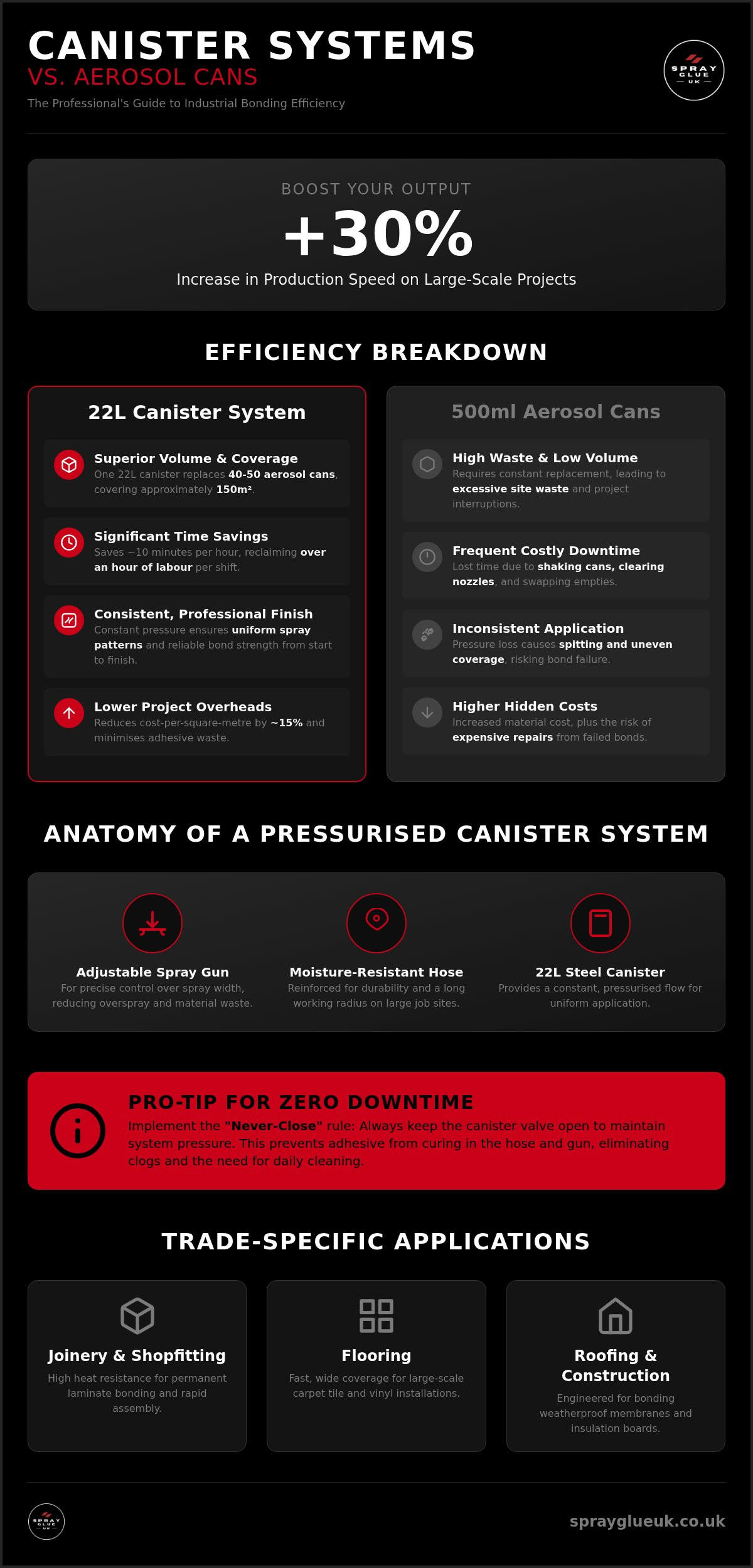
Industrial data confirms that switching from standard aerosol cans to 22L canister systems increases production speed by 30% on large-scale projects. It's a significant margin that directly impacts your daily output and project profitability. You likely already know that relying on 500ml cans for high-volume bonding leads to excessive waste, frequent downtime, and inconsistent spray patterns that risk bond failure. Every minute spent shaking a fresh can or clearing a clogged nozzle is lost revenue.
This guide demonstrates why trade spray adhesive canisters are the professional standard for high-strength industrial bonds and long-term cost efficiency. We'll examine the technical advantages of systems like the Premium Bond 22L and the precision offered by an Adjustable Contact Adhesive Gun. You'll learn how to reduce project overheads, achieve faster application speeds, and maintain a zero-maintenance workflow that keeps your workshop operational. We'll break down the hardware requirements, flash-off times, and the specific benefits of trade-grade canisters for the UK market. By the end, you'll have a clear roadmap to upgrading your bonding process for maximum reliability.
Key Takeaways
- Reduce project overheads and site waste by replacing dozens of 500ml aerosols with a single, high-volume 22L system.
- Implement the "Never-Close" rule to maintain internal pressure and prevent adhesive clogs in your hose and spray gun.
- Identify the most effective trade spray adhesive canisters for your sector, from high-heat roofing solutions to permanent shopfitting bonds.
- Optimise application precision using adjustable contact adhesive guns and moisture-resistant reinforced hoses for consistent, professional-grade results.
- Streamline your workflow with starter kits that provide all essential hardware for immediate, high-speed industrial bonding.
Understanding Trade Spray Adhesive Canisters
A 22L canister system isn't just a larger version of an aerosol; it's a mobile industrial station. These trade spray adhesive canisters provide a constant, pressurised flow that ensures uniform application from the first square metre to the last. Unlike standard cans that lose pressure as they empty, these systems use a dedicated propellant to maintain a consistent discharge rate. This reliability is critical for professionals who cannot afford the bond failures associated with spluttering or uneven coverage.
The system relies on three core components: the steel canister, a moisture-resistant reinforced hose, and an adjustable spray gun. The adhesive itself is typically a high-performance Pressure-Sensitive Adhesive (PSA) that creates a permanent bond upon contact. Most trade applications favour a web spray pattern. This lace-like distribution provides high coverage with minimal soak-in, ensuring more adhesive stays on the surface where it's needed most. It creates a stronger bond with less material, directly reducing project costs.
The Mechanics of Pressurised Systems
Internal pressure is the engine of the system. It forces the adhesive through the hose at a velocity that standard aerosols can't match. A 22L canister is a portable, non-flammable propellant system for trade use. The valve system is equally vital. By keeping the canister valve open, the system remains pressurised, which prevents the adhesive from curing inside the hose or gun. This closed-loop design eliminates the need for daily cleaning and prevents the equipment clogs that cause costly downtime on-site. You get a tool that's ready to fire the moment you pull the trigger.
Key Trade Applications
Efficiency drives the demand for these systems across multiple sectors. In high-volume joinery, products like Premium Bond 22L provide the high heat resistance required for permanent laminate bonding. The speed of application makes it the standard for shopfitting where deadlines are tight. In the flooring industry, canisters are used for large-scale carpet tile and vinyl installations. The adjustable gun allows for wide, rapid coverage on subfloors, significantly reducing project time. For roofing and construction, specialist formulations like Roof Tack 22L are engineered to handle weatherproof membranes and insulation boards. These canisters perform in demanding environments where traditional bonding methods are too slow or lack the necessary industrial strength.
Trade Efficiency: Canisters vs. Traditional Aerosols
One 22L canister replaces roughly 40 to 50 standard 500ml aerosols. This isn't just a matter of volume; it's about eliminating the constant cycle of shaking, spraying, and discarding small cans. Research indicates that canister systems save approximately 10 minutes per hour of active spraying. Over a full shift, that's over an hour of reclaimed labour time. Trade spray adhesive canisters maintain constant pressure until the tank is empty, ensuring the first and last square metre receive identical coverage.
Precision control is a major advantage of the canister system. Standard aerosols often "spit" or lose pattern consistency as the propellant depletes, leading to uneven bonding. Using an adjustable gun allows you to dial in the exact spray width required for the task. This reduces overspray and adhesive waste by ensuring the glue lands only on the target surface. From an environmental perspective, managing the disposal of one empty steel canister is far more efficient and cost-effective than handling dozens of hazardous aerosol tins.
Cost-Per-Square-Metre Breakdown
A 22-litre canister covers approximately 150 square metres. This bulk capacity reduces the cost per square metre by about 15% compared to individual cans. When you factor in the 30% increase in production speed on large projects, the total overhead drops significantly. You avoid the hidden costs of bond failure caused by the uneven application common in depleting aerosols. Professionals looking to maximise these margins should consider a Spray Adhesive Starter Kit to transition away from inefficient aerosol setups.
Portability and On-Site Practicality
Whilst canisters are heavier than individual cans, they provide superior mobility on-site. A long, reinforced hose provides a massive working radius, allowing you to move around large workpieces or across rooms without carrying the weight of the unit. It's a completely self-contained system. You don't need compressors, bulky hoses, or external power sources. Safety is also a priority; while we adhere to UK standards, many global manufacturers align with federal labeling requirements for flammable contact adhesives to ensure clear hazard communication across the trade. Storing one 22L unit is more space-efficient and easier to inventory than multiple boxes of loose aerosols.
The Anatomy of a 22L Pressurised Canister System
Technical reliability starts with the hardware. These trade spray adhesive canisters are constructed from high-grade steel to house a pressurised 22-litre volume safely. Each unit features a heavy-duty safety valve to manage internal pressure fluctuations and prevent accidental discharge. This build quality ensures the system remains a sturdy, dependable link in your workshop's supply chain. It's a self-contained station that eliminates the need for external power or compressors.
Connecting the tank to the gun is a moisture-resistant reinforced hose. Standard rubber hoses often fail because atmospheric moisture seeps through the walls, causing the adhesive to cure and block the line. A professional-grade, moisture-locked hose prevents this chemical reaction. It ensures a smooth, uninterrupted flow from the tank to the nozzle. This component is vital for maintaining the zero-maintenance reliability that trade professionals expect from industrial equipment.
The Adjustable Spray Gun
The Adjustable Contact Adhesive Gun is the precision tool of the system. Its adjustable tip allows for spray widths ranging from 25mm for fine edge work to 300mm for broad surface coverage. This versatility is essential for all-day trade use. The ergonomic trigger design reduces hand fatigue during large-scale projects. It's specifically engineered to handle high-solids formulations without clogging, ensuring consistent lace patterns every time. Flow control is managed via a rear adjustment screw, allowing you to calibrate the output based on the material's porosity.
Adhesive Formulations: Premium Bond and Beyond
The chemistry inside the canister determines the bond's success. High-solids contact adhesives, such as Premium Bond 22L, contain over 35% solid content. This means more adhesive remains on the surface after the solvent evaporates, creating a superior industrial bond. Flash-off times are critical for performance. Most industrial formulations require 2 to 5 minutes to become "tacky" before bonding. Once ready, the "open time" provides a window of up to 24 hours for some products, though most trades align surfaces within 20 minutes for maximum grab.
For environments exposed to high temperatures, such as vehicle linings or roofing, high-heat resistance is mandatory. Products like Roof Tack 22L are engineered for these weatherproof applications, often resisting temperatures up to 110 degrees Celsius. Modern workshops also prioritise DCM-free (Dichloromethane-free) options to improve operator safety without compromising on tack speed. Selecting the correct formulation ensures the tool matches the specific technical challenges of your trade sector.
Professional Setup and Maintenance for Zero Downtime
Correct assembly is the foundation of operational efficiency. When using trade spray adhesive canisters, the goal is to maintain a completely sealed, pressurised environment. Begin by attaching the reinforced hose to the canister valve. Ensure the connection is tight using a spanner to prevent solvent evaporation. Next, attach the Adjustable Contact Adhesive Gun to the other end of the hose. Once secure, fully open the canister valve. This initial pressurisation primes the system for immediate use.
The "Never-Close" Rule is the most critical maintenance practice. Once the system is pressurised, leave the canister valve in the open position. Keeping the adhesive under constant pressure prevents it from curing inside the hose or gun body. You only close the valve when the canister is empty and ready for replacement. This simple protocol eliminates the risk of internal blockages and ensures the tool is ready to fire at the start of every shift.
Initial System Assembly
Before pressurising, inspect all seals and O-rings for damage. A compromised seal allows the solvent to escape, which leads to the adhesive thickening and eventually clogging the gun. Tighten all threaded connections firmly but avoid over-tightening, which can crush the gaskets. To prime the hose, point the gun into a waste container and pull the trigger until a consistent, steady spray pattern is achieved. This removes any air pockets and ensures the first application on your workpiece is uniform.
To safely swap canisters, close the valve on the empty tank. Trigger the gun to bleed off the remaining pressure in the hose. Once the flow stops, disconnect the hose and immediately attach it to the fresh canister. Open the new valve immediately to re-pressurise the line. For those new to these systems, an all-in-one Spray Adhesive Starter Kit includes the necessary hardware to ensure your first setup is seamless and leak-free.
Troubleshooting Common Issues
If the spray pattern becomes streaky or inconsistent, the spray tip is likely partially obstructed. Use a dedicated solvent cleaner or a brass wire brush to clear the nozzle whilst on-site. Never use steel pins or sharp objects, as these can damage the precision-engineered tip. For long-term storage, ensure the gun's safety lock is engaged and the system remains pressurised. If you must disconnect the gun for extended periods, flush the hose with a compatible cleaning agent to prevent the adhesive from setting into a solid mass. Regular checks on the hose for kinks or external wear will prevent sudden pressure drops during critical bonding phases.
Selecting the Right Canister for Your Trade Sector
Selecting the correct adhesive formulation is as vital as the hardware itself. For joinery and shopfitting, the priority is a high-strength, permanent bond that resists constant tension. Trade spray adhesive canisters like the Premium Bond 22L are engineered specifically for these rigorous environments. They ensure that heavy-duty laminates and veneers remain fixed even under the stress of daily use in commercial settings. The high-solids content ensures the bond doesn't become brittle over time.
In roofing and construction, environmental factors dictate the choice of product. Roof Tack 22L is the industry standard for bonding weatherproof membranes and insulation boards. It provides the high-heat resistance, up to 110 degrees Celsius, necessary to withstand direct sunlight on flat roofs without bond degradation. This stability is critical whilst working on large-scale external projects where temperature fluctuations are extreme. It ensures the integrity of the building envelope remains intact regardless of the weather conditions.
Vehicle converters also rely on these systems for bonding heavy-duty linings and acoustic insulation in campervans. The speed of application is a primary driver in the flooring sector too. Large-scale carpet tile or vinyl installations require the rapid, wide-pattern coverage that only trade spray adhesive canisters can provide. This efficiency allows contractors to complete large square-metre areas in a fraction of the time required by traditional rollers or small aerosols.
The Spray Glue UK Starter Kit Advantage
Transitioning from aerosols to a professional system is simplified with the Spray Adhesive Starter Kit. It's the logical choice for new users because it provides a complete, ready-to-use station. Each kit includes a 22L canister, a professional spray gun, a reinforced hose, and essential cleaning agents. This setup ensures you have the correct technical specifications from day one, avoiding the compatibility issues often found when mixing hardware from different suppliers. You can customise your kit based on whether you require high-heat resistance or standard industrial bonding.
Maximising Bond Strength on Different Substrates
Achieving industrial-grade results on MDF, plywood, or laminates requires more than just high-quality glue. Surfaces must be dry, free from dust, and non-greasy before you begin. Highly porous substrates like MDF may require a light primer coat of adhesive before the main application to ensure a solid foundation. Using the Adjustable Contact Adhesive Gun allows for precision application, ensuring the adhesive is distributed evenly without soaking into the core of the material. This control maximises bond strength and prevents the starved joints that lead to failure. Always ensure you achieve 80% to 100% coverage on both surfaces for a permanent, high-tension bond.
Optimise Your Professional Bonding Process
Adopting trade spray adhesive canisters is the most effective way to reduce project overheads and increase site speed. By replacing dozens of inefficient aerosols with a single 22L system, you eliminate unnecessary downtime and achieve more consistent coverage. Whether you require the ultimate heat resistance of Premium Bond 22L or the weatherproof durability of Roof Tack 22L, selecting the right industrial formulation ensures your bonds withstand the most demanding environments.
Reliability is built into every component, from the moisture-resistant hoses to the adjustable spray guns. Our systems are designed for tradespeople who value precision and high-volume performance without the fuss of constant maintenance. We provide expert technical support for all trade enquiries to help you select the perfect hardware for your specific sector needs. Maintain your workflow and secure your next project with professional-grade tools delivered exactly when you need them.
View our range of Trade Spray Adhesive Canister Starter Kits to streamline your workshop today. With next-day UK delivery as standard, you can begin improving your production efficiency and bond reliability immediately.
Frequently Asked Questions
How long does a 22L spray adhesive canister last compared to aerosols?
A 22L canister typically replaces 40 to 50 standard 500ml aerosol cans and covers approximately 150 square metres. This high-volume capacity significantly reduces the downtime spent changing cans and decreases the cost per square metre by about 15%. Because trade spray adhesive canisters maintain constant pressure, you achieve uniform coverage from the start to the end of the tank, preventing the adhesive waste common with depleting aerosols.
Can I leave the gun and hose attached to the canister when not in use?
Yes, you must leave the gun and hose attached and the canister valve in the open position. This "Never-Close" rule keeps the adhesive under constant pressure, preventing it from curing or skinning over inside the line. Closing the valve allows air to enter, which leads to blockages. As long as the gun's safety lock is engaged, the system remains ready for immediate use at the start of your next shift.
Do I need a compressor to use a trade spray adhesive canister?
No, these systems are completely self-contained and don't require external power or air compressors. The adhesive is housed in a pressurised steel tank with a dedicated propellant that forces the material through the hose. This portability makes them ideal for on-site work and mobile trade applications where access to power is limited. You simply connect the hose and gun to start spraying immediately without any additional hardware.
What happens if the spray adhesive gun gets blocked?
If the nozzle becomes obstructed, use a dedicated solvent cleaner or a brass wire brush to clear the tip. Avoid using steel pins or sharp metal objects, as these can permanently damage the precision-engineered spray tip and ruin the web pattern. Regular daily checks and keeping the system pressurised will prevent most blockages. If the blockage is internal, the hose may need flushing with a compatible cleaning agent to restore flow.
Are trade canisters suitable for high-temperature applications like campervan lining?
Specialist formulations like Premium Bond 22L are specifically engineered for high-heat environments such as vehicle conversions. These adhesives provide heat resistance up to 110 degrees Celsius, ensuring that linings and insulation don't peel away when the vehicle's metal skin heats up in direct sunlight. This industrial-grade thermal stability is a critical requirement for campervan, marine, and roofing applications where standard aerosols often fail under thermal stress and lose their bond.
How do I know when the canister is empty and needs replacing?
You'll notice the spray pattern beginning to splutter or become inconsistent as the adhesive volume depletes. The canister will also feel significantly lighter when lifted; an empty 22L tank weighs much less than a full unit. Once the flow stops, close the valve, bleed the remaining pressure from the hose by triggering the gun into a waste container, and immediately swap to a fresh canister to keep the system operational.
Is it cheaper to use a canister system for small trade jobs?
While the initial investment in a starter kit is higher than a single aerosol, the cost per litre is significantly lower. For tradespeople who perform regular small jobs, trade spray adhesive canisters pay for themselves through reduced waste and faster application speeds. The zero-maintenance design means you don't lose money on clogged cans or bond failures. If your work is frequent, the long-term savings on labour and materials are substantial.
What is the flash-off time for industrial contact adhesive canisters?
Most trade-grade contact adhesives require a flash-off time of 2 to 5 minutes depending on the ambient temperature and humidity. The adhesive is ready for bonding when it feels tacky to the touch but doesn't transfer to your finger. Bonding too early traps solvent between the substrates, which leads to bubbling or eventual bond failure. Always ensure the solvent has fully evaporated before pressing the two surfaces together for a permanent fix.